Description
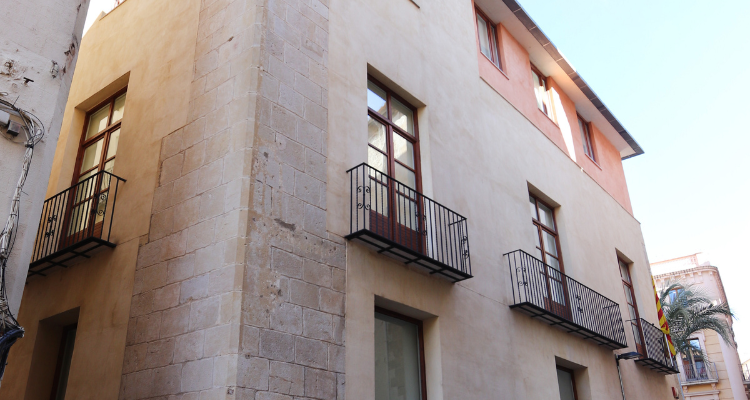
Abària Palace in Tortosa is a former Gothic palace located on Carrer de Montcada, one of the historic thoroughfares of the old town. The building preserves features that reveal its evolution from the Middle Ages to the present day. Among the most distinctive are its medieval gargoyles and surviving sections of the original structure.
Over the centuries, the palace underwent significant changes. One of the most important took place in the 19th century, when it was adapted as the residence of a wealthy family. Today, it houses the Territorial Delegation of the Government of Catalonia in Terres de l’Ebre and is not open for tourist visits. Therefore, its heritage can be appreciated from the outside and through its interesting urban surroundings.
Abària Palace in Tortosa, a Gothic residence
The origins of Abària Palace in Tortosa date from the 14th and 15th centuries. It was originally a fortified urban palace, combining the functions of a residence with features associated with defensive architecture.
The building had a small tower at each corner, giving it a very different appearance from the one seen today. Despite later alterations, sections of the medieval masonry still survive, particularly at the corners and around some of the openings.
In addition, the medieval gargoyles are among the most distinctive features visible from the outside. They were preserved and enhanced during the modern restoration of the building.
The Abària family and Tortosa
The palace is historically associated with the Abària family, a lineage with a significant presence in Tortosa during the early modern period.
Its members included Llop d’Abària, who was of Basque origin, and his son Martí d’Abària. Both are documented as master builders associated with work on Tortosa Cathedral during the 16th century.
The family remained connected with the city in later centuries. One notable 19th-century member was Clotilde d’Abària i Fortuny, known in Barcelona artistic circles as “the Pearl of Tortosa”. Her portrait, painted by Francesc Masriera in 1878, forms part of Tortosa’s municipal art collection.
From a medieval palace to a 19th-century residence
Abària Palace underwent several transformations throughout its history. During the 19th century, the building was extensively remodelled to serve as the residence of a wealthy family.
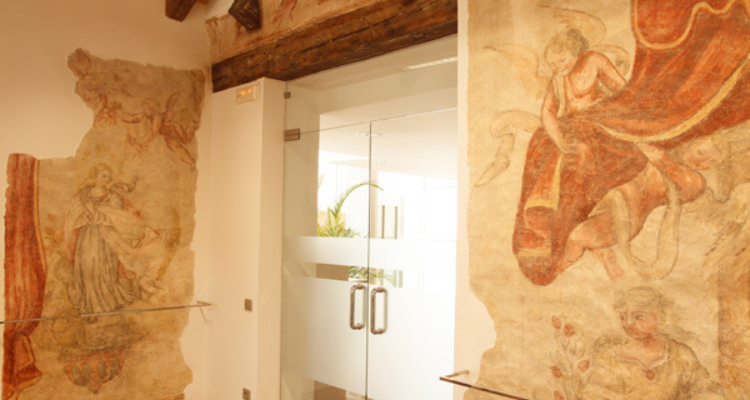
Inside, mosaic floors and mural paintings from this period survive alongside features of medieval origin. Thus, the building preserves different layers of its history, from the former Gothic palace to the 19th-century residence.
At the beginning of the 21st century, an extensive restoration project was undertaken. The work adapted the building to its current institutional use while preserving heritage features from different periods. The project was completed in 2006.
Abària Palace and Plaça dels Dolors
The exterior of the palace can be appreciated together with Plaça dels Dolors, the square beside the building. This space helps visitors understand the urban transformations that have taken place in this part of the historic centre.
The former Dolors Church once stood here and was associated with the convent of the Sisters of the Sacred Heart, also known locally as the Dolors community. The Baroque church was severely damaged during the Spanish Civil War.
The subsequent redevelopment of the area incorporated some of the surviving remains of the former church. In addition, the outline of its apse is marked on the paving of the square, helping visitors visualise the layout of the lost building.
The routes of the former Carrer de Sant Antoni and Censal d’en Costa were also marked in the paving. Therefore, the square reveals several traces of Tortosa’s earlier urban landscape.
A palace to discover from the outside
Abària Palace is not open for tourist visits. As the building currently has an administrative function, its heritage should be discovered from Carrer de Montcada and Plaça dels Dolors.
From the street, visitors can observe the façade, the medieval gargoyles and other surviving features of the historic building. Moreover, the square provides an opportunity to discover the remains of the former Església dels Dolors and interpret the historic street patterns marked in the paving.
The mosaics, 19th-century mural paintings and other interior features form part of the palace’s heritage. However, they are not part of the visitor experience, as the interior is not open to tourists.
Finally, Abària Palace is an interesting stop on a walk along Carrer de Montcada and through Tortosa’s old town. Its Gothic origins, later transformations, medieval gargoyles and Plaça dels Dolors reveal different layers of the city’s urban history from the surrounding public space.