Description
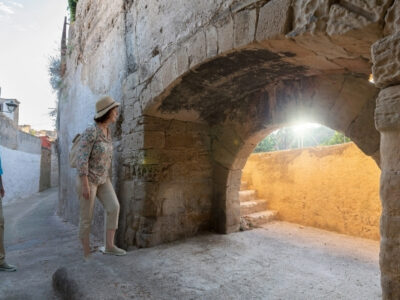
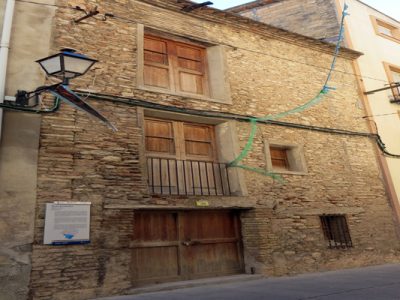
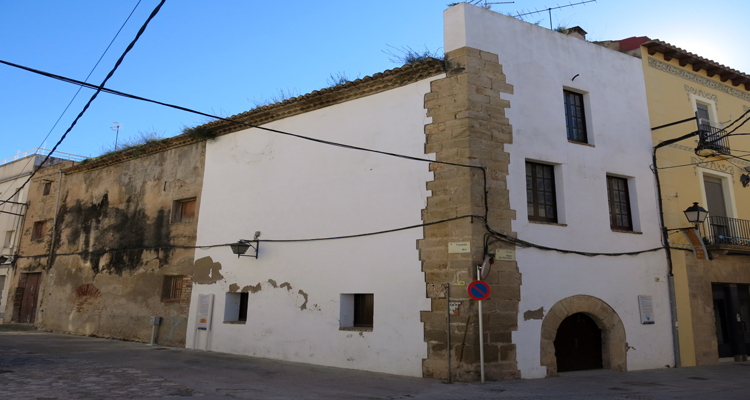
The House of Sant Jordi or the Synagogue is a building of medieval origin located on Carrer Major de Remolins, within Tortosa’s Jewish Quarter. For many years, it was popularly identified as the former synagogue of the neighbourhood. However, current research does not provide sufficient evidence to confirm this interpretation.
The building preserves remains of earlier construction, but the available historical evidence points to other uses throughout its history. In fact, the most widely accepted hypothesis associates the medieval building with the Hospital of Sant Jordi. It was later also used for military purposes.
House of Sant Jordi Tortosa in the Jewish Quarter
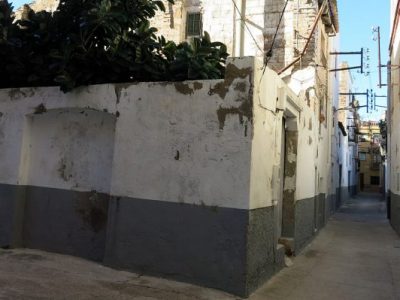
The location of the house is particularly significant. It stands at the end of Carrer Major de Remolins, close to the site of the former Vimpeçol Gate, which no longer survives. This was one of the main entrances to the city and connected Tortosa with settlements on the left bank of the River Ebro and with the royal road towards Zaragoza.
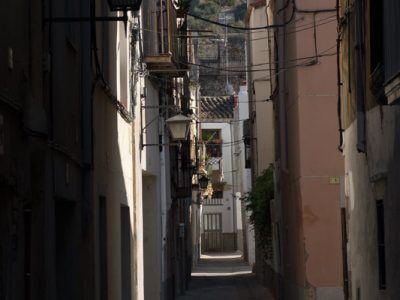
In addition, Carrer Major de Remolins separated the Old Jewish Quarter and the New Jewish Quarter. Exploring this area therefore helps place the House of Sant Jordi within an urban landscape closely connected with medieval Tortosa.
A synagogue? A traditional identification
The House of Sant Jordi or the Synagogue has traditionally been considered the former synagogue of the Jewish Quarter. This identification became particularly widespread following interpretations proposed by various authors in the early 20th century.
However, subsequent research calls for a more cautious interpretation. Archaeology does not completely rule out this possibility, as the building preserves remains of earlier construction. Nevertheless, archival evidence does not confirm that the synagogue was located here.
In fact, historical sources place the main communal spaces of the Old Jewish Quarter, including the synagogue, in another area. Therefore, the name “the Synagogue” should be understood as a traditional identification rather than as a historically proven fact.
The Hospital of Sant Jordi and later uses
The hypothesis linking the building to the Hospital of Sant Jordi is based, among other factors, on the dimensions, layout and location of the former complex. Medieval hospitals were often situated near city entrances. In this case, its proximity to the former Vimpeçol Gate supports this interpretation.
Later, the function of the building changed. From the beginning of the 18th century, it is documented as a military facility and cavalry barracks, known as the Prince’s Barracks or Remolins Barracks.
The building that survives today represents only part of what was originally a much larger complex. It remained state-owned until 1860, when it was acquired by a private owner. Subsequent inheritances and sales led to the subdivision of the property.
A building for understanding the Jewish Quarter
Today, the House of Sant Jordi is of interest both for its medieval origins and for the different interpretations it has generated over time. As a result, it also provides an example of how historical and archaeological research can reassess identifications that were accepted for decades.
Its location on Carrer Major de Remolins also helps place the building within the urban layout of the Jewish Quarter and Tortosa’s former defensive system.
Finally, the House of Sant Jordi or the Synagogue forms part of the route through Tortosa’s Jewish Quarter. Its history, its different uses and its proximity to the former Vimpeçol Gate provide an insight into the transformations of this part of the city over the centuries.