Description
The Hermitage of Saint Barnabas, historically also known as Saint Gregory of the Mills, is located approximately one kilometre from the village of Jesús. It stands on a small hill near the Molins del Comte (Count’s Mills) and the Cervera Valley. Terraced fields, olive trees and carob trees give the area its distinctive rural character.
Saint Barnabas is also a long-established local place name, used for the Sant Bernabé rural area. The existence of a hermitage here has been documented since the Middle Ages. However, the building that survives today is much later.
Hermitage of Saint Barnabas and its medieval origins
Historical records confirm the existence of the former hermitage by at least 1347. Later, in 1440, it was transferred to the Franciscans. The original building was a Gothic structure facing east. However, no visible remains of this medieval hermitage survive.
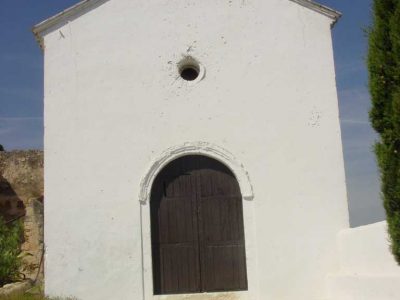
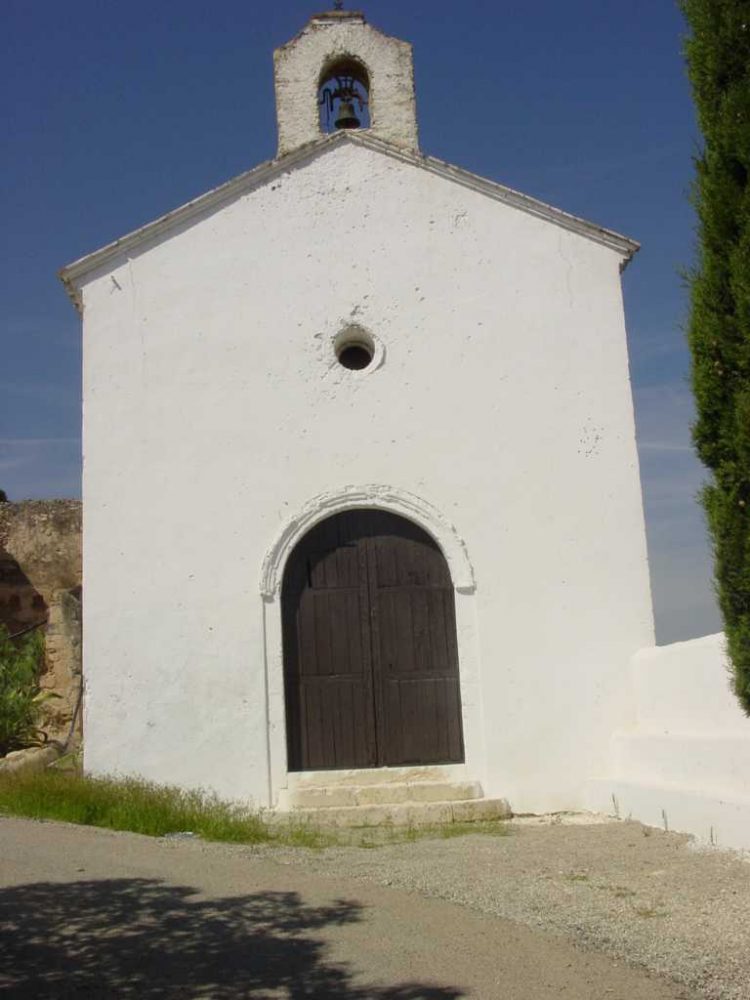
The present hermitage dates from the 19th-20th centuries. Its architecture is simple and well suited to its rural surroundings. It has a rectangular plan and a façade with a round-arched doorway and an oculus. A small bell gable crowns the building.
Its characteristic white façade stands out on the small hill amid the surrounding vegetation. A row of cypress trees also contributes to the distinctive appearance of the site.
From Saint Gregory of the Mills to Saint Barnabas
The two names are one of the distinctive features of the hermitage. Historical sources refer to it as Saint Gregory of the Mills, while over time the name Saint Barnabas became established.
The former name reflects its proximity to the Molins del Comte, a group of medieval watermills. The mills used the local water supply and the natural slope of the land to operate. They are documented from the 12th century and are among the most interesting heritage features in this area.
Thus, the hermitage and the mills form part of the same historic landscape. Their proximity helps visitors understand the traditional organisation and uses of this rural territory.
The Saint Barnabas pilgrimage
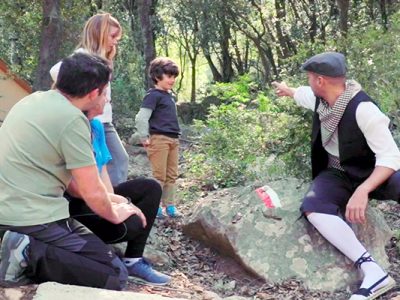
The connection between Jesús and the hermitage remains alive through the Feast of Saint Barnabas. The pilgrimage was revived with the aim of preserving an old local tradition. When restoring the celebration, the organisers also drew on the memories of older residents of the village.
Traditionally, participants make the pilgrimage on foot and in horse-drawn carriages. The route begins at the Pèrgola de la Immaculada, in the centre of Jesús, and continues along the road towards Els Reguers. It then follows the Cervera Valley road until reaching the hermitage.
On arrival, Mass is celebrated inside the small chapel. The festivities then continue outdoors, where participants gather and enjoy the rural surroundings.
Baldana, coqueta and local tradition
Food also plays an important role in the celebration. The traditional afternoon snack features baldana and coqueta, two foods closely associated with local gastronomy.
In addition, special commemorative ribbons are produced for each edition of the festival. They help preserve the memory of the pilgrimage and form part of the traditional elements revived with the celebration.
In this way, the Feast of Saint Barnabas brings together devotion, gastronomy, landscape and community life. At the same time, it helps pass local traditions from one generation to the next.
The Goigs of Saint Barnabas
The revival of the Goigs of Saint Barnabas is another important element of the intangible heritage associated with the hermitage. Students from the Jesús School of Music worked from an old musical score to update the goigs and bring their performance back to life.
The Sant Francesc Choir and the Jesús Music Band have also taken part in performing the goigs. Therefore, music and devotion form part of the celebration and help preserve the cultural memory associated with Saint Barnabas.
Routes around Saint Barnabas
The location of the hermitage also provides an opportunity to discover the rural landscape surrounding Jesús. The paths through the Cervera Valley, terraced fields and nearby Molins del Comte are all part of this setting.
In addition, the Hermitage of Saint Barnabas is a stopping point on one of the cycling routes promoted by Tortosa Tourism. The approximately 24-kilometre itinerary “Along the Paths of the Count-King, Saints and Romantic Banditry” passes through Jesús and Els Reguers. It then reaches the Molins del Comte and Saint Barnabas before returning towards the Greenway.
The hermitage is therefore an interesting place to combine heritage, cycling and rural landscapes.
A hermitage linked to the memory of Jesús
The Hermitage of Saint Barnabas is particularly significant as a place closely connected with the collective memory of Jesús. Its former name, Saint Gregory of the Mills, recalls its historical relationship with the nearby medieval mills.
Finally, the pilgrimage, the Goigs of Saint Barnabas, Mass, baldana and coqueta keep the hermitage’s intangible heritage alive. Meanwhile, the Molins del Comte and the paths through the Cervera Valley offer an opportunity to discover a lesser-known part of Tortosa’s rural heritage.
The interior of the hermitage opens for celebrations such as the Feast of Saint Barnabas, but there is no regular visiting schedule. Outside these occasions, the site can mainly be appreciated from the exterior and through its landscape and surrounding paths.