Description
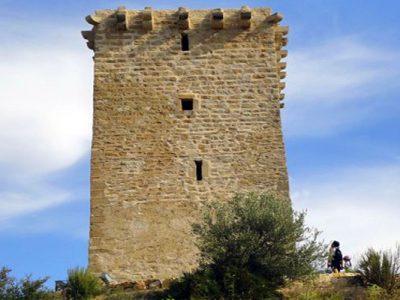
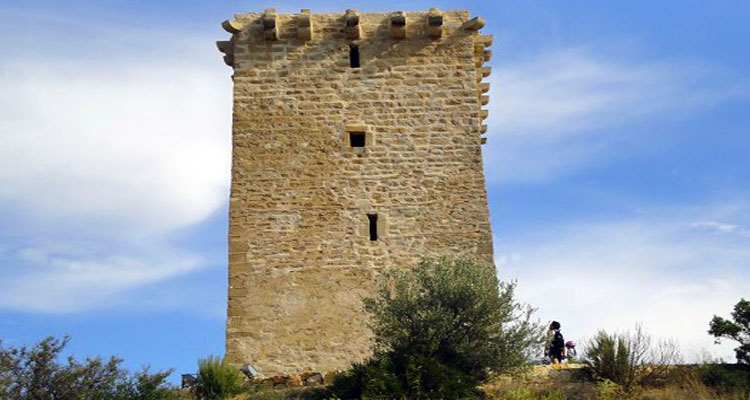
The Font de Quinto Tower is one of the most representative examples of Campredó’s medieval heritage. Also known as Ayuso Tower or Campredó Tower, it stands on a hill on the river-facing slopes of the Serra de les Veles. From this position, it overlooks the lower Ebro and a wide area of the surrounding agricultural plain.
The tower is associated with the former possessions of the Order of the Temple and the medieval organisation of this territory. In addition, its surroundings reveal another decisive period in more recent history: the Battle of the Ebro. Interpretation panels, graffiti preserved inside the tower and other nearby remains help explain the fighting that took place in this sector in July 1938.
Font de Quinto Tower and the Templar heritage
In 1182, the territories south-east of Tortosa passed into the hands of the Order of the Temple through a royal donation. These lands were organised around the Prat sub-commandery, established to administer the Templar possessions in this area.
The Font de Quinto Tower is historically associated with this territory. Sources date its construction to the medieval period, between the 13th and 14th centuries. Therefore, it is one of the most important surviving reminders of Campredó’s Templar past.
Nearby stands the Casa del Prat, also known as the Llotja, another key element of this heritage complex. Together, the tower and the Llotja help explain a medieval landscape shaped by farmland, grazing areas, routes and strategic points of control.
A defensive tower overlooking the Ebro
The tower is a fortified rectangular structure with a distinctive prism-shaped profile. It stands approximately 11 metres high, with a base measuring around 8.20 by 6 metres. Its walls are built of small, irregular stone blocks bonded with mortar.
One of its most characteristic features is the original elevated entrance, a common defensive feature in medieval towers. This arrangement made access more difficult and improved the building’s protection. In addition, the tower preserves arrow slits and other features associated with its defensive role.
The different interior levels were connected by trapdoors. There was also a fireplace on the upper floor, indicating the existence of a space with residential functions.
Over time, the tower underwent several alterations. In fact, it was later used as a farmhouse, a change of use that probably contributed to its preservation.
Campredó Tower and control of the river
The elevated position of the Font de Quinto Tower provided extensive views over the lower Ebro. The river was an important route for communication, transport and access to Tortosa. Therefore, controlling this corridor was of considerable strategic importance.
On the opposite bank of the Ebro stands La Carrova Tower, with which the Campredó tower maintains a clear visual connection. Moreover, sources also associate this surveillance system with the former Sant Onofre Tower, which no longer survives.
According to local tradition, the Campredó and La Carrova towers were connected by a system of chains that could prevent boats from travelling along the Ebro. However, this account belongs to local tradition and should not be regarded as a documented historical fact.
Font de Quinto Tower and the Battle of the Ebro
The history of the tower continued long after the Middle Ages. During the Spanish Civil War, this part of Campredó was directly involved in the opening stages of the Battle of the Ebro, during the early hours of 25 July 1938.
In this sector, Republican forces attempted to cross the Ebro as part of a diversionary operation. The aim was to disperse Francoist forces while the main Republican offensive crossed the river further north. The operation involved the XIV International Brigade, known as La Marseillaise, whose ranks included many French and Belgian volunteers. The fighting resulted in heavy casualties.
Inside the tower, graffiti associated with members of the XIV International Brigade has been preserved. These inscriptions provide direct evidence of the presence of the International Brigades and add another historical layer to the medieval building.
In addition, interpretation panels dedicated to the Spanish Civil War and the Battle of the Ebro can be found around the tower. They explain the Republican operation of 25 July 1938 and place Campredó within the southern sector of the battle.
A remembrance route through Campredó, L’Aldea and Amposta
The interpretation around Font de Quinto Tower forms part of a historical remembrance project shared by Campredó, L’Aldea and Amposta. It connects several sites associated with Republican attempts to cross the Ebro during the opening hours of the battle.
These locations include Font de Quinto Tower, La Carrova Tower, Mas de Talarn and Mas de Bernis. Thus, the interpretation panels help visitors understand the fighting from a broader territorial perspective rather than as an isolated event.
Around Campredó, the interpretation is complemented by other remains, particularly the restored trenches near Casa del Prat. Therefore, the same area brings together traces of both the Middle Ages and the Spanish Civil War.
From medieval heritage to historical memory
This combination of different periods is one of the main attractions of the Font de Quinto Tower. The medieval structure reflects the organisation and control of the territory during the Templar period. By contrast, the graffiti, trenches and interpretation panels provide an insight into the events of 1938.
Therefore, a visit offers a broad perspective on Campredó’s history. Within a relatively small area, visitors can discover a medieval defensive tower, remains from the Spanish Civil War and a landscape that reveals the strategic importance of the Ebro over the centuries.
In 2000, Font de Quinto Tower and Casa del Prat became the property of Tortosa City Council. Subsequently, restoration and heritage interpretation projects were undertaken to preserve and enhance the site.
A viewpoint over the lower Ebro
The location is another of the great attractions of the Font de Quinto Tower. The building stands on a hill between the higher ground of the Serra de les Veles and the Ebro floodplain.
From the surrounding area, visitors can enjoy wide views over the river, the agricultural plain and the Campredó landscape. These panoramas make it easy to understand why this location was strategically important at different periods in history.
Thus, discovering the tower is not only about its architecture. The landscape is an essential part of the experience and helps explain the relationship between the fortification, the territory and the Ebro.
Cycling routes around Font de Quinto Tower
The tower also forms part of cycling routes through Campredó. One of these is the family-friendly “Through Campredó along secondary roads” route, a circular itinerary of approximately 30 kilometres starting and finishing in Tortosa.
The route initially follows the Ebro Nature Trail towards Campredó. After passing through Font de Quinto, it approaches the tower and offers excellent views over the river.
In this way, medieval heritage and historical memory can be combined with cycling and the discovery of the Ebro landscape.
The tower and the Ebro Way of Saint James
The Font de Quinto Tower also lies near the Ebro Way of Saint James. This pilgrimage route follows the river corridor, linking Amposta with Tortosa before continuing northwards.
The tower is one of the heritage sites associated with this section of the route. Therefore, its surroundings can be incorporated into walking or cycling itineraries combining heritage, landscapes and historic routes.
A tower to discover from the outside
The Font de Quinto Tower has been restored, but it does not have regular permanent opening hours for independent visits to its interior. The building hosts cultural activities and may open on specific occasions. Therefore, visitors should not expect guaranteed access inside.
A typical visit focuses on the exterior of the tower, its defensive architecture, the surrounding landscape and the interpretation features nearby. These resources provide an insight into both its medieval past and the Spanish Civil War events associated with this sector.
Finally, Ayuso Tower, Font de Quinto Tower or Campredó Tower brings together centuries of history in a single setting. Its Templar heritage, the medieval control of the Ebro, the Battle of the Ebro and the river landscape make the tower and its surroundings one of Campredó’s most interesting heritage sites.