Description
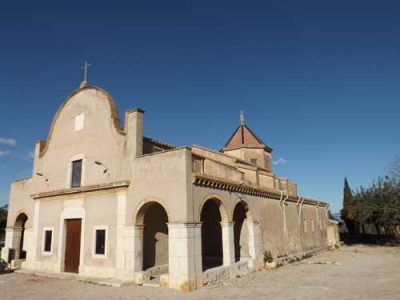
The Petja Hermitage, also known as the Sanctuary of Our Lady of the Angels of La Petja, is one of the surviving examples of Gothic heritage on the outskirts of Tortosa. It stands in the Sant Llàtzer area, around three kilometres from the city centre, in a landscape traditionally associated with agriculture.
The sanctuary dates back to 12 April 1378, when Guerau de Montbrú, Archdeacon of Culla, commissioned the construction of a chapel beside his house and the former Petja Tower. In addition, he established a benefice for the priest responsible for the church. The sanctuary was originally known as Santa Maria de la Petja.
Petja Hermitage, an example of Tortosa’s Gothic heritage
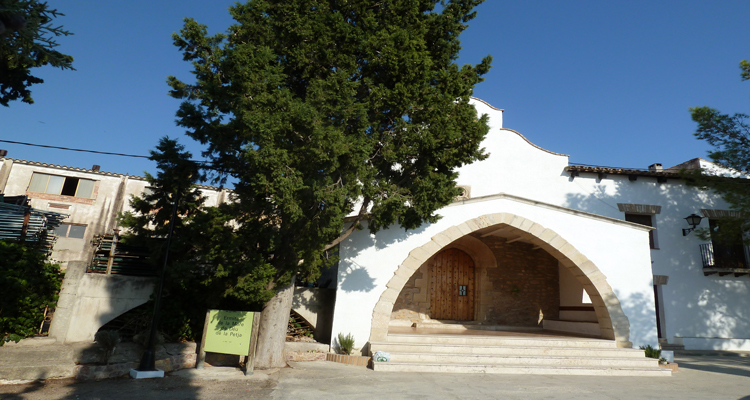
Despite the many alterations it has undergone over the centuries, the hermitage preserves several elements of its original Gothic structure. The pointed-arch main doorway is particularly noteworthy, with large stone voussoirs and capitals decorated with plant motifs. The Montbrú coat of arms, featuring a fleur-de-lis, can also be seen on these capitals.
In addition, a Gothic window with lobed openings survives in the upper part of the façade. The church consists of a small rectangular nave reinforced externally by buttresses. Therefore, despite subsequent reconstructions, several features of the building’s medieval origins can still be identified on the exterior.
A hermitage shaped by successive reconstructions
The history of the sanctuary has been marked by several periods of destruction and rebuilding. It suffered damage during the conflicts of the 17th century and was subsequently restored in 1789. However, the Napoleonic Wars caused further damage. Later, the complex was also damaged during the Spanish Civil War and subsequently restored again.
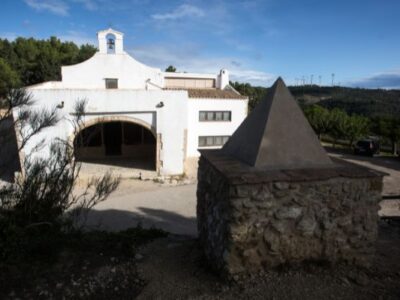
Near the hermitage are the remains of the Creu de la Petja, or Petja Cross, dating from the 12th century. This feature adds to the historical interest of a site with deep-rooted connections to the surrounding area.
Living heritage on the outskirts of Tortosa
The hermitage remains closely connected with Tortosa’s religious and popular traditions. In fact, celebrations in honour of Our Lady of La Petja continued to take place in 2026, organised by the Associació Amics de l’Ermita de la Petja.
The building is protected as a Cultural Asset of Local Interest (BCIL). In addition, the old Barcelona road that passes through this area forms part of cycling routes promoted by Tortosa Turisme, making it possible to include the hermitage in a route through the rural landscape surrounding the city.
The interior is not currently open for unrestricted visits, and there is no regular public opening schedule. Therefore, a visit mainly offers the opportunity to appreciate the exterior of the complex, its Gothic doorway and the surrounding landscape.